
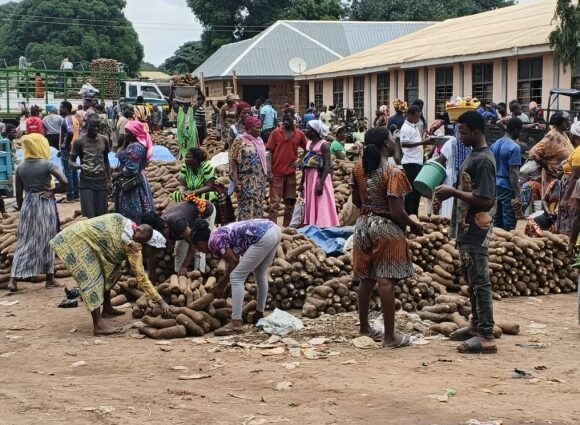
It is a Wednesday morning in Kpandai. As clouds gather, many would prefer to stay curled up in bed to enjoy the coming rain or perhaps ask their parents for “chop money.” But not 28-year-old Helen Kando. Instead, she heads straight to the bustling yam market. A graduate of the University of Education, Winneba, Helen spends her day buying and selling yams, a trade that sustained her education and lifted her family out of hardship.
Helen ventured into yam trading in 2020, at the height of the COVID-19 outbreak, when her mother fell ill and her family struggled to pay hospital bills. With just GH¢500, she began by reselling three to six tubers of yam. Four years on, she has completed her tertiary education, settled her mother’s medical bills, and continues to thrive as a trader.
“The yam business paid for my school fees, accommodation, and even my mother’s medical bills. It gave me independence,” she told Graphic Online’s Simon Unyan.
Her story has inspired many young women in Kpandai to pursue yam trading and education, rather than migrate to southern cities for “kayaye” (head porting) or fall into early marriages.
Women turning to trade instead of ‘Kayaye’
Helen’s experience reflects a broader transformation in Kpandai. Not long ago, many schoolgirls travelled to Accra or Kumasi during vacations for menial jobs. Today, more are staying back, building small businesses, and financing their education.
“This yam market has changed things for us. Before, when school vacated, the next option was ‘kayaye’. Now, most of us are staying back and finding opportunities here,” another trader explained.
Teenage pregnancy and early marriage declining
This shift is also influencing social change, particularly in reducing teenage pregnancy and early marriage.
Nationally, 14.2 per cent of adolescent girls aged 15–19 had begun childbearing, according to the 2022 Ghana Health Service report. The 2021 Population and Housing Census shows that 19 per cent of Ghanaian girls marry before 18, with the figure rising to 33 per cent in the Northern Region. The region also records one of the highest adolescent birth rates in the country—89 births per 1,000 girls aged 15–19, compared to the national average of 72 per 1,000 (GSS/UNFPA).
Accommodation services in Ghana
In Kpandai, however, community leaders say these worrying figures are gradually improving.
“The issues of unwanted pregnancy, early marriage, and over-dependency are reducing because most women here are now actively busy at the market and contributing to their households,” said District Chief Executive (DCE), Mr Haruna Abdul Karim.
Trading away galamsey
The yam market is not only reshaping women’s lives but also redirecting young men away from illegal mining.
“Farming and agriculture in Kpandai are flourishing, and many youth are abandoning galamsey for yam farming and trade,” the DCE observed.
He cautioned against galamsey, stressing that it destroys water bodies, the environment, and human life. “Farming is lucrative, and if land is available in the district, the youth should take advantage of it,” he added.
Women building wealth
For women, yam trading has become a ladder to financial empowerment. Female traders are acquiring land, building houses, purchasing motorbikes, and funding their children’s education. Some are even advancing to universities, teacher training, and nursing colleges.
“These women are no longer just dependents—they contribute meaningfully to household income and community development,” Mr Karim noted.
One trader, Ms Rita, shared her story: “Though I couldn’t further my education after secondary school, I’m proud to be funding my two siblings at nursing training college. The business has also allowed me to buy land and start building a house, for which I’m grateful to God.”
Challenges in the yam trade
Despite its promise, yam trading in Kpandai faces significant hurdles. Access to credit remains a challenge, with high interest rates discouraging borrowing. Traders are calling on the government to establish the long-promised Women’s Development Bank to provide soft loans for women in agribusiness.
Rising input costs are another burden. GH¢5,000 now buys between 200 and 300 tubers of yam compared with about 300 and 400 previously. Ploughing costs have also risen from GH¢200 to between GH¢300 and GH¢350 per acre, despite recent fuel price reductions.
Market leaders are also urging the establishment of Agricultural Mechanisation Centres to reduce production costs and support farmers.
Assembly’s support plan
The DCE described yam trading as the backbone of Kpandai’s economy and called for stronger measures to sustain it.
“The assembly is engaging with traders to form cooperatives to ease access to credit. Plans are also underway to relocate the yam market to a more spacious government land to improve safety and reduce congestion on the road,” Mr Karim emphasised.
A harvest of empowerment
From Helen Kando’s resilience to the determination of women across Kpandai, the yam market has grown beyond being a centre of trade. It is now a symbol of dignity, empowerment, and social change.
“The yam market gave me hope when I thought my dreams had ended,” Helen reflected. “Now, I’m independent, educated, and supporting my family. I encourage other young women to see the opportunities here rather than leaving for uncertain lives in Accra or Kumasi.”
