
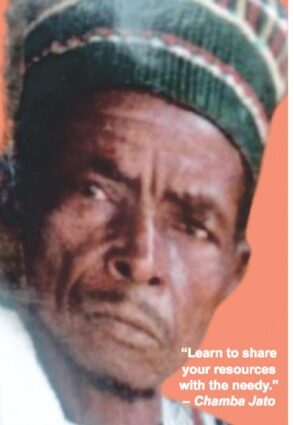
Here is a true story of my father, Chamba Jato, then called Sanbian, which took place in the year of our Lord 1932, when he was a young boy growing up in the north.
He told me this story himself and explained why he wanted me to know.
One evening
It was evening at Nadawk, a small town nestled among scanty trees and shrubs.
The smoke curling out of homes was settling, indicating that the women were done with cooking their supper.
Households that didn’t have anything to cook—and there were many of them—would sleep on empty stomachs that evening, for the times were hard.
Two boys, holding their begging bowls, lurked about in the dark, ready to enter a house.
“Let’s go before they finish eating,” said Sanbian, the older boy who looked more famished.
His friend hesitated, but Sanbian dragged him to the entrance.
A dog began to growl at the sound of their footsteps, but they were not deterred.
The beggars
“Who’s there?” a woman asked from within the house. “Oh!” she said when she saw who they were. She recognised them as area boys.
“Who was that?” That was a male voice coming from within the open compound.
“Two boys,” the woman told her husband.
What do they want?”
In answer, the woman went back inside, followed by Sanbian and his friend.
It was dinner time in that house, and the man, on seeing the boys, knew what they wanted.
One other boy with the same mission left a moment earlier.
It was a frequent phenomenon in those hard times when some children went about from house to house begging for supper or sleep on empty stomachs.
“Come,” the man spoke to the two boys.
When they approached him, he cut a morsel of TZ they were eating, dropped it in their bowls, poured some soup on it.
Their mission accomplished, the boys stepped out and gratefully ate what had been given to them.
They didn’t sleep on empty stomachs that night.
Foodless homes
Didn’t the boys have homes to eat in?
They had homes, but it was not every home that had supper every evening, which was why many slept on empty stomachs.
The next evening, Sanbian and his friend went to another house.
This time, however, the story was significantly different.
Three young men were eating from the same bowl when the two boys appeared at the entrance.
A smile formed on one man’s face, which Sanbian couldn’t interpret it.
Was that a sign of hope that they would be given a morsel of food or was that a sign of mockery?
Sanbian was aware that begging for food lacked dignity, but when hunger attacked the stomach and chewed it continuously, dignity was easily overlooked.
The young man’s smile appeared to indicate hope, for he placed something in a potsherd and stretched it towards the boys, one to Sanbian and another to his friend.
The two boys were grateful as they went out to eat what they thought were morsels of food.
Deceived
Outside, it was Sanbian who yelled out first, followed by his friend, and they could hear the laughter coming from the house.
The poor boys had been deceived.
What they got was not morsels of food but round stones smeared with some of the food to make them look like food morsels.
So when the boys bit into what should have been food, they bid into solid pebbles.
As they went away into the night holding their hurting jaws, they could still hear the mischievous laughter from the wicked young man.
Sanbian and his friend had never experienced such wickedness before, and it set Sanbian thinking: perhaps dignity was, after all, stronger than hunger.
Better brave hunger than suffer humiliation.
Henceforth, he resolved, he would not allow hunger to drive him into acts of humiliation.
The lesson
Sanbian and his friend slept on empty stomachs that night, but it was not the hunger than worried them as much as the ill-treatment they suffered. The boy Sanbian never forgot this story but made sure to tell it to his children someday.
Over 70 years later, the boy Sanbian, no longer a boy but an old man called Chamba Jato, having his own large household, remembered to narrate this story to us, his children.
With many travel adventures and extensive work and experiences behind him, he recalled this story with thanksgiving to God for his goodness towards him and his family.
“I’m telling you this humiliating story,” he said, “not to degrade myself or attribute wrongdoing to anybody, but that you, my children, will learn to give and share your resources with the needy.”
