
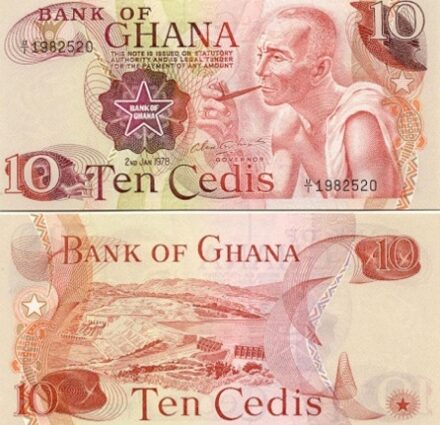
On the occasion of the Central Bank’s marking of the 60th anniversary of the cedi, many memories flood my mind, which reveal my ‘hide and seek’ pursuit of the cedi over the decades. However, one particular event stands out.
When I gained admission to Achimota School in the 1970s, the stipulated amount in total pocket money in the school prospectus, was the princely sum of 3 cedis.
Yes, a “colossal” amount of just three cedis, was supposedly enough to last the entire term! Anything above that, was “non-school”, and could be promptly seized, with punishment to follow.
The next academic year, inflation dictated an increase in the pocket money limit, to five cedis for the entire duration of the term.
In those days, the largest currency denomination was the ten-cedi note, referred to as the _”jato”_ for it’s red colour. And the old man depicted on the note, was regarded as the “godfather” for good reason.
To the really rich, the red notes were commonplace, a normal part of life. But the wannabes in society used the ten-cedi notes to ‘flex’ in public, flaunting them like achievement certificates in their fight against poverty.
So the “jato” was revered by those of us poor folk who only experienced rare sightings of that red bill, because it was almost extinct in our world.
Now, somewhere down the line, my wealthy uncle, an Old Achimotan himself, paid me a very rare visit in school one weekend. Still seated in the back seat of his Mercedes, he casually extended a “jato” towards my hand.
I was so shocked by the jaw-dropping amount, that in my confusion I mumbled some nonsense, and promptly ran off towards the Housemaster’s quarters to break the money into smaller notes. I simply could not believe the man intended to give me the whole shebang!
But his driver, Wofa Adu, shouted after me in Twi, _”Hey, Nana Yaw, wookor he?”_ (Where are you going?) To which I responded meekly that I was going to fetch some change.
Thankfully, my uncle saved me from my foolishness, and ordered me to return, assuring me that the “jato” was all mine (much to the annoyance and envy of the driver). My mouth was agape with shock!
Whaaat? Me? A whole ten cedis!?
Man, I was rich!
Money swine!
But soon after he was gone, every rich man’s dread and anxiety overcame my poor self: I could not sleep peacefully that night, in paranoid fear that my grand fortune would be stolen.
Trust me, this was a very real and present danger, because my boarding House was NOT a monastery full of monks. Oh, no! It was more like a penitentiary.
Needless to say, ya boy was “rich” for the rest of the term, financially liberated from the constant calculations and worries about my small budget, whenever I bought even a small pie with a coin.
And for once, I could confidently approach the school’s Snack Square with a smirk and a swagger.
Oh yes, with my generous tax-free windfall, I could now put the fear of God into all those vendors at the snack market, an arena I had often feared to tread.
Ah, money sweet!
In the ensuing years, I learnt that no matter it’s value, if you respected our currency, it would respect you back.
Today, the cedi’s largest denomination, the two-hundred note, also has a similar red hue. But let’s face it, it lacks the sheer aura and swag of the original “jato”. That was truly the O.G., the original godfather of cedis.
©️2025 CY Pitt.
