
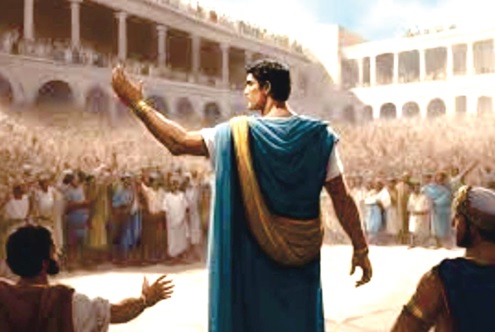
Charisma, personality, dignity.
These are powerful cousins in the same household, the house being any group of people, be it family, workplace, community, the church and even the nation.
Some people have such astounding natural talent for public speaking that they easily sway the masses towards a certain direction.
And if such charismatic orators have the added gift of great personality and enviable dignity, they soon rise to become leaders that many people follow—for better or for worse.
Typical example
A typical example was the well-known orator Mark Antony in William Shakespeare’s play Julius Caesar, who was particularly famous for his competent funeral speech for the Roman governor Caesar.
According to scholars, Mark Antony’s masterful use of literary devices such as irony, pathos (i.e. sadness or pity), logic, sarcasm, metaphor, hyperbole (i.e. repetition) and other figures of speech enabled him to appeal to the emotions of the Roman mob against those who murdered the governor.
In Ghana, we have had examples of powerful speakers at the level of Roman orators who have swayed us to follow them and their Utopian ideas. Apparently, great ideas and how well they are communicated may or may not always lead us to our desired end.
Therefore, the gift of charisma, personality or dignity that an individual wields should be wisely weighed before patronage, in order not to be led astray.
Like Apollos
I’m driving this talk into the church where we are often prone to over-subscribing to our founders’ and leaders’ charismatic oratory, to the extent that we get easily misled or misinformed.
A case in point was Apollos, an eloquent Jewish Christian from Alexander whose charisma and personality captivated a large number of believers in Ephesus.
Church history reports that Apollos was a gifted and persuasive preacher who debated opponents of Christianity so forcefully that he was soon noticed by the leadership of the church as an apostle.
It is said that, “He was a learned man, with a thorough knowledge of the Scriptures . . . though he knew only the baptism of John” (Acts 18:24, 25).
Trailing behind
We learn from Acts 18:24-25 that, despite his zeal and charisma, Apollos was propounding a doctrine that was based on the teaching of John the Baptist.
Of course, the church had moved on past John who came to prepare the way for the Lord Jesus Christ. Apollos was thus trailing behind in his knowledge of the true doctrine of the church.
So, you see, zeal and charisma, useful as they are, cannot take the place of sound biblical doctrine and teaching; otherwise a charismatic leader can zealously lead people astray.
When seasoned church leaders, Priscilla and Aquila, heard Apollos and realised what he lacked, “they invited him to their home and explained to him the way of God more adequately” (Acts 18:26).
To his credit, Apollos was a humble person in addition to being charismatic.
He respectfully studied under the coaching of Priscilla and Aquila and became more effective in his teaching and apostolic zeal.
Misled members
The story of Apollos offers a good example of a charismatic leader who was humble and ready to learn.
The same cannot be said of many leaders today who are endowed with charisma and a desirable personality.
Often, however, members of the congregation pave the way for such leaders to lead them away from the truth.
An example is the church in Corinth that easily followed human personalities rather than Christ and biblical doctrine.
Paul wrote to them, “I could not address you as people who live by the Spirit but as people who are still worldly—mere infants in Christ” (1 Corinthians 3:1).
The problem Paul detected was that there was jealousy and quarrelling among them.
Apparently, jealousy, quarrelling, backbiting, and bickering are evidence of carnality and lack of spiritual growth in any congregation.
Baby Christian
This Baby-Christian attitude was manifested by some who said they followed Paul; others said they followed Apollos; while others said they followed Silas.
“What, after all, is Apollos?” Paul questioned them. “And what is Paul?
Only servants, through whom you came to believe—as the Lord had assigned to each his task.”
The baby Christians in the Corinthian congregation were swayed by the charisma and personality of their leaders, leading to their lack of growth.
The history of the church in this country is replete with denominations that split into factions due to the actions and utterances of their leaders and their followers.
Sometimes, the situation shrouds the message, making the leaders fail in their mission—the mission of declaring the Good News of the grace of God.
What we need to understand is that God endows leaders with different leadership and teaching styles, different personality and skill for the purpose of growing the church for Christ, not for displaying and basking in empty charisma.
The writer is a publisher, author, writer-trainer and CEO of Step Publishers.
